Over-the-counter hearing aids are a good thing. They lowered the price of entry for millions of people, and for some of them they may work well.
They are also not right for everyone, and the hard part is that you cannot always tell which group you are in without a test. Here is the comparison as we would give it to you in the exam room, including the cases where we would tell you to try OTC first.
What actually changed
The FDA created the over-the-counter category in a final rule published in August 2022, effective October 17, 2022. It covers certain air-conduction hearing aids for adults 18 and older with perceived mild to moderate hearing loss, sold without a medical exam, a prescription or a professional fitting. Devices for more severe loss, and for anyone under 18, remain prescription devices.
The word doing the most work in that sentence is perceived. The rule lets you decide for yourself whether your loss is mild to moderate. It does not make that judgment reliable.
For the wider picture, see how hearing aid technology has changed.
The comparison
| OTC | Prescription | |
| Who it’s for | Adults 18+, perceived mild to moderate loss | Any degree of loss, any pattern, any age |
| How it’s set up | You, using an app or built-in test | Programmed to your audiogram and verified in your ear |
| Verification | None | Real-ear measurement |
| Typical price | Lower, device only | Higher, usually bundled with care |
| Follow-up | Customer support | Your audiologist, over years |
| Catches medical problems | No | Yes, part of the evaluation |
Where OTC genuinely works
- Mild loss, confirmed rather than assumed
- Comfortable with an app and willing to fine-tune
- Symmetrical hearing, no ringing, no dizziness, no ear pain or drainage
- Wanting to try amplification before committing to a larger purchase
If it turns out you need prescription devices, here is what hearing aids cost here.
Where OTC tends to disappoint
- Loss that is worse than it feels, which is common; high-frequency loss reduces clarity rather than volume, so people underestimate it
- Asymmetric loss, where one ear is clearly worse
- Loss that is more than moderate, where an OTC device cannot deliver enough gain in the frequencies you need
- Poor speech understanding, where making sound louder does not make it clearer
- Tinnitus, dizziness, ear pain or drainage, which need evaluation first
- Anyone who has had ear surgery or sudden hearing change
If your loss is beyond what OTC can handle, there are other treatments that work for hearing loss.
The thing no OTC device does
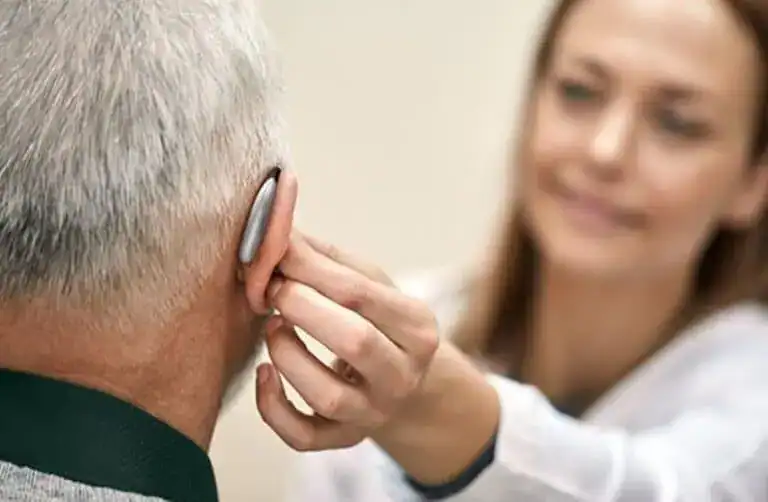
A prescription fitting includes real-ear measurement: a thin probe microphone sits in your ear canal while the device runs, and confirms that the sound actually reaching your eardrum matches what your hearing loss calls for. Ear canals differ enough that a device programmed correctly on paper can still be wrong in your ear.
OTC devices have no equivalent. You are the verification.
Get the test either way
Even where a medical or audiological evaluation is not required, the FDA itself suggests considering a hearing evaluation to establish the type and degree of your hearing loss before buying a hearing aid. Mayo Clinic makes the same point, with an audiologist there saying nothing takes the place of a good hearing evaluation.
FDA also notes why: hearing loss can be a sign of something easily treated, such as earwax, or something that needs attention, such as a tumor on the hearing nerve. An OTC purchase skips that check.
Our position is not that everyone needs a prescription device. It is that everyone should know their audiogram before spending money on either kind.
That starts with a comprehensive hearing evaluation.
What we do if OTC is right for you
We will tell you. If your evaluation shows mild loss and a good OTC candidacy, we will say so, and we can help you pick a device and verify how it performs in your ear. You are not obliged to buy anything here.
If a prescription device is the better fit, you can see the hearing aids we fit.
Frequently asked questions
Are AirPods hearing aids?
The FDA authorized a hearing aid software feature for compatible AirPods Pro, making them an OTC hearing aid for adults 18 and older with perceived mild to moderate loss. It is a real regulated category, not a workaround, and it carries the same limits as any OTC device.
What is the difference between an OTC hearing aid and a sound amplifier?
Personal sound amplification products are not regulated as medical devices. OTC hearing aids are.
I bought an OTC device and it did not help. What now?
Common, and usually informative. Either the device was not delivering the right sound, or your loss is beyond what it can handle. An evaluation answers which.
Can I bring my OTC device to an appointment?
Yes. Bring it.
Know your hearing before you spend on either kind.
References
- S. Food and Drug Administration. OTC Hearing Aids: What You Should Know. fda.gov
- S. Food and Drug Administration. How to Get Hearing Aids. fda.gov
- S. Food and Drug Administration. Hearing Aids and Personal Sound Amplification Products: What to Know. fda.gov
- S. Food and Drug Administration. FDA Authorizes First Over-the-Counter Hearing Aid Software. fda.gov
- National Institute on Deafness and Other Communication Disorders. Over-the-Counter Hearing Aids.nih.gov
Mayo Clinic News Network. What Mayo Clinic experts want you to know about over-the-counter hearing aids. newsnetwork.mayoclinic.org
Service