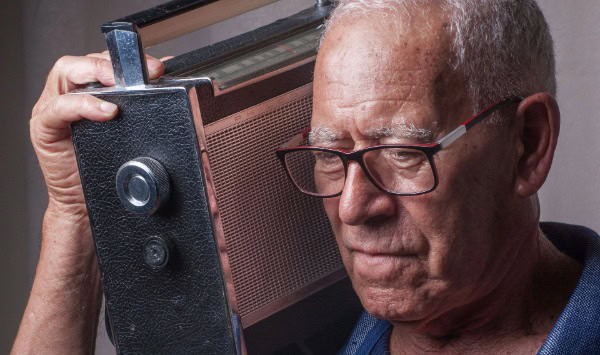
This article is written for the person who noticed first. Usually it is an adult child, a spouse, or a sibling, and usually the worry arrives quietly: Dad did not answer a direct question at dinner. Mom asked the same thing twice. Someone seems to be withdrawing from conversations they used to enjoy.
Those are real signs. They just do not tell you which of two very different problems you are looking at — and one of them is far easier to check.
Why the two look identical from across a table
If someone does not hear a question, they cannot answer it. If they hear half of it, they answer the wrong half. If they never registered the information, they will ask for it again.
From the outside, all three look like forgetting. They are not.
High-frequency hearing loss, which is the most common pattern with age, does not make speech quieter. It makes it less distinct: consonants blur, so “fifty” and “sixty” sound alike. People adapt for years without realizing what has changed, and often conclude that everyone else has started mumbling.
Hearing loss also puts a real load on memory
This is the part families are rarely told. The strain of hard listening is itself measurable.

Harvard Health, reporting on a meta-analysis of 36 studies covering more than 20,000 people, describes an association between age-related hearing loss and weaker performance across several cognitive domains, including memory, executive function and processing speed — an association that held after accounting for risk factors such as blood pressure and smoking. One explanation researchers offer: hearing loss demands extra mental effort to decode speech, leaving fewer resources for everything else, including remembering what was said. Here is a closer look at how hearing and brain health connect.
Johns Hopkins Medicine reports that in a study following 639 adults for nearly 12 years, mild hearing loss was associated with roughly double the dementia risk, moderate loss roughly triple, and severe loss around five times. These are associations, not proof of cause, and the ranges in the underlying data are wide. But they are why hearing is on the list of things to check early rather than late. For a fuller look at the evidence, see what the research shows.
Signs that point toward hearing
- Hears fine one-to-one in a quiet room, struggles badly in restaurants or group conversations
- Turns the television up; others in the house find it too loud
- Answers a question that was not quite the one asked
- Asks people to repeat, or says “what?” then answers before it is repeated
- Withdraws from noisy gatherings but is fine at a quiet lunch
- Says others mumble
- Seems tired after social events out of proportion to the effort
For a longer checklist, see the ten early signs of hearing loss.
Signs that point toward memory or thinking
- Trouble recalling recent events even when the conversation was clearly heard
- Repeating the same story or question within a short span, in a quiet setting
- Getting lost on a familiar route
- Difficulty with familiar tasks: paying bills, following a recipe, using the phone
- Losing track of the day, date or season
- Changes in judgment, mood or personality
- Word-finding difficulty in writing as well as speech
The setting is the most useful clue. Trouble that appears mainly in noise, and disappears one-to-one in a quiet room, points toward hearing. Trouble that is just as present in a quiet room does not.
These lists do not diagnose anything. If what you are seeing sits in the second list, speak with a physician. Hearing and memory can both be involved, and often are.
Why check hearing first
Three practical reasons.
It is quick, painless and non-invasive. It is often treatable, which is not true of most causes of memory change. And treating it may help. A three-year study enrolled 977 adults aged 70 to 84 who had untreated hearing loss. Half were given hearing aids and ongoing care from an audiologist; the other half took part in a health education program instead. Among the 238 participants who were already at higher risk — older, with more risk factors — hearing treatment slowed the loss of thinking and memory abilities by 48%. Among the 739 healthier volunteers it made no measurable difference — that group was declining too slowly for three years to show anything either way. So this is a reason to check hearing early, not a promise about dementia.
A hearing evaluation also removes a variable. If hearing turns out to be part of the picture, some of what worried you may ease. If it is not, you have ruled something out before the harder conversation.
How to raise it without a fight
This conversation goes wrong when it sounds like a verdict.
- Lead with a moment, not a diagnosis: “I noticed you left the table early at Sarah’s.”
- Talk about effort, not deficit: “Does it feel like work to follow conversation in a loud room?”
- Offer to go with them, and to make the appointment yourself
- Frame it as information: a test tells you what is going on, and commits them to nothing
- Skip the word “aids” entirely in the first conversation
What happens at the visit
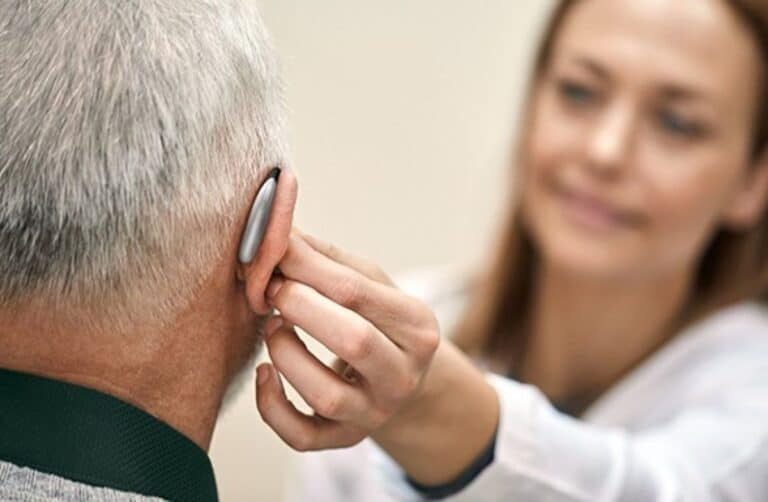
A comprehensive hearing evaluation here includes tones, speech understanding in quiet and in background noise, and middle ear function. Because families arrive with exactly this question, we also assess listening effort and auditory working memory, which is what our cognitive hearing assessment measures.
You are welcome to come in with them. Bring the examples you have noticed; specifics are more useful to us than a summary.
Frequently asked questions
Can hearing loss cause dementia?
No research shows that it causes dementia. Research consistently shows an association, and the 2024 Lancet Commission treats hearing loss as one of the modifiable risk factors worth addressing. Association is not causation, and treatment is risk reduction, not prevention.
Will hearing aids restore my parent’s memory?
No. What treating hearing loss can do is remove the listening strain that makes memory look worse than it is, and keep someone socially engaged which can support overall brain health.
They refuse to be tested. What now?
This is common; people adapt so gradually that they do not believe anything has changed. Two things help: a referral from their own physician, and going to the appointment with them.
If you are not sure which one you are looking at, start with the one you can measure.
Clinical note: This article is educational and is not a substitute for individual evaluation. Concerns about memory, judgment or daily function should be discussed with a physician.
References
- Johns Hopkins Medicine. The Hidden Risks of Hearing Loss.
- Harvard Health Publishing. Hearing loss a possible risk factor for dementia.harvard.edu
- Harvard Health Publishing. Hearing aids may reduce cognitive decline.harvard.edu
- Johns Hopkins Bloomberg School of Public Health. Hearing Loss and the Dementia Connection.jhu.edu
- Livingston G, et al. Dementia prevention, intervention, and care: 2024 report of the Lancet Commission. The Lancet. 2024;404(10452):572–628.
Service